Mark McCluskey
The GodfatherMark McCluskey is a New York police captain whose authority appears to represent law and order but is secretly purchased by Virgil Sollozzo. His brief presence in the plot has consequences far beyond his individual role: by assaulting Michael Corleone at the French Hospital and then accompanying Virgil Sollozzo as his armed protector, McCluskey turns a criminal dispute into a confrontation with the state. His death therefore becomes the act that transforms Michael from an uninvolved war hero into a central operative of the Corleone Family.
Identity and Public Authority
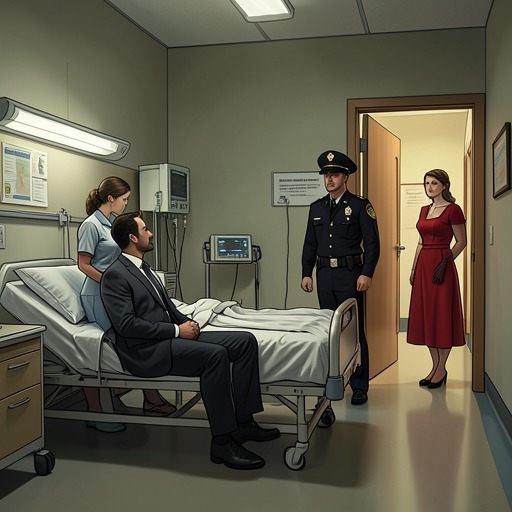
McCluskey first appears at the French Hospital after police cars flood the entrance. He is physically imposing, a massive captain with gold braid on his cap, white hair showing beneath it, and a beefy red face. Rather than treating Michael as a civilian who has come to protect his wounded father, he assumes that Michael belongs to the criminal world and orders his men to seize him. A detective immediately identifies Michael as Don Vito Corleone’s son, while another points out that Michael is clean, a war hero, and untouched by the rackets. McCluskey nevertheless insists that Michael be locked up, revealing how quickly his official judgment is overridden by hostility and prejudice.
The captain’s authority is also theatrical. He presents himself as the guardian of public order, yet when Michael asks how much Virgil Sollozzo is paying him to set up Don Vito Corleone, McCluskey responds with violence rather than an investigation. He orders the patrolmen to hold Michael while he strikes him in the face, breaking his teeth and badly swelling his cheekbone. Immediately afterward, McCluskey falsely declares that he did not touch Michael and claims that Michael attacked him and resisted arrest. The scene exposes the power of an official who can injure a civilian and then manufacture the legal version of what happened.
Connection to Virgil Sollozzo
Tom Hagen later confirms that McCluskey is on Virgil Sollozzo’s payroll for substantial money. The arrangement is not limited to ordinary corruption: McCluskey is promised a share of Sollozzo’s narcotics operation and has agreed to serve as Sollozzo’s personal bodyguard. Because he is a police captain, his protection makes Sollozzo effectively untouchable. The other New York families understand that killing a captain would bring overwhelming police, newspaper, church, and political pressure upon the Corleone Family, so McCluskey’s badge functions as a shield around Sollozzo and as a strategic weapon against Don Vito Corleone.
This position makes McCluskey the point where official institutions and organized crime meet. The Corleone Family relies on political protection and carefully layered organization, but McCluskey represents a more direct form of institutional capture: the officer who should enforce the law instead protects murder and drugs. His corruption also helps explain why Michael’s proposed action is so dangerous. Eliminating Sollozzo alone might be treated as a family conflict; eliminating Sollozzo while killing a police captain risks making the Corleone Family an outcast among the Five Families and destroying the political protection that has sustained it.
The Restaurant Meeting and Death
McCluskey accompanies Virgil Sollozzo to the meeting with Michael, wearing civilian clothes but carrying his gun. Before the encounter, he adopts a falsely conciliatory manner. He apologizes for the hospital assault, describes himself as too old and too grouchy for the job, and pats Michael’s shoulder with apparent affection. He then conducts a thorough search for weapons. The performance is calculated to make McCluskey look like a tired, repentant public servant while preserving his practical role as Sollozzo’s armed security.
The meeting is moved through a deliberately evasive route, crossing the George Washington Bridge before the driver reverses direction and returns toward the East Bronx. At the restaurant, McCluskey sits beside Sollozzo and eats veal while Michael listens to a conversation that has become unintelligible under the pressure of the moment. Michael draws a concealed gun and shoots Sollozzo first. McCluskey initially looks at the killing with confident outrage, as though Michael will surrender or flee. Michael then shoots him in the throat and follows with a second shot through the top of his skull. The captain’s badge, physical strength, and institutional protection cannot save him once Michael has accepted the logic of retaliation.
Consequences and Public Reclassification
McCluskey’s murder intensifies the 1947 war between the Corleone Family and the Five Families. Police pressure becomes unusually severe because the victim was an operating official of the New York Police Department. The Corleone Family’s gambling income is damaged as runners are arrested, banks are raided, and parts of the numbers operation are abandoned. McCluskey’s position thus makes his death costly even though his corruption had helped make the meeting possible.
Tom Hagen counters the political danger by planting newspaper stories proving that McCluskey received large cash payments shortly before his death and was involved with Virgil Sollozzo. The Police Department does not officially confirm or deny the reports, but information spreads through informers and officers connected to the Corleone Family. McCluskey is gradually reclassified from a respectable captain into a rogue policeman who accepted the dirtiest money: money connected with murder and drugs. The distinction matters within the police culture described by the narrative. Ordinary graft may be tolerated as a familiar abuse of office, whereas participation in murder and narcotics makes McCluskey morally unforgivable even to other policemen.
His posthumous exposure also demonstrates that power depends on control of records and public interpretation as much as on force. McCluskey had used his uniform and official statement to define Michael as a resisting hoodlum; after his death, Hagen uses payments, newspaper reports, and police rumor to define McCluskey as a criminal. Neither version is produced by a neutral institution. Each is manufactured through access to authority, information, and networks of influence.
Narrative Role and Significance
McCluskey is less a fully developed private personality than a concentrated embodiment of institutional corruption. His scenes move him through three incompatible identities: the intimidating police captain at the hospital, the paid protector beside Virgil Sollozzo, and the disgraced rogue cop whose corruption is revealed after death. The changes do not redeem him; they show how competing systems name and use the same man. To Michael, McCluskey is the obstacle preventing access to Sollozzo. To Sollozzo, he is protection. To the police after the shooting, he becomes a liability whose connection to criminal money must be absorbed or denied.
His decisive importance lies in the effect he has on Michael Corleone. The assault at the hospital gives Michael a personal reason to understand the captain’s vulnerability, but Michael insists that the plan is logical rather than a response to the blow. He argues that he is the only person who can approach both targets, that Santino Corleone must remain responsible for the family, and that Fredo Corleone is incapacitated by shock. McCluskey’s violence therefore helps expose Michael’s latent capacity without being presented as its sole cause. When Michael kills him, the boundary between the Corleone Family and the institutions it opposes is permanently crossed.
The consequences continue after the immediate war. At a later meeting in Don Vito Corleone’s library, the family’s strained succession and declining New York position are discussed against the background of the peace with the Five Families. Yet the eventual political maneuvering makes Michael the most powerful Family chief in the United States. By the time the New York operation is closed and the family’s headquarters and Long Beach property are sold, the Corleone Family is unchallengeable. McCluskey’s death was one of the costs of that ascent and one of the acts that made it possible: the corrupt guardian of the old order becomes the corpse around which Michael’s new order is built.